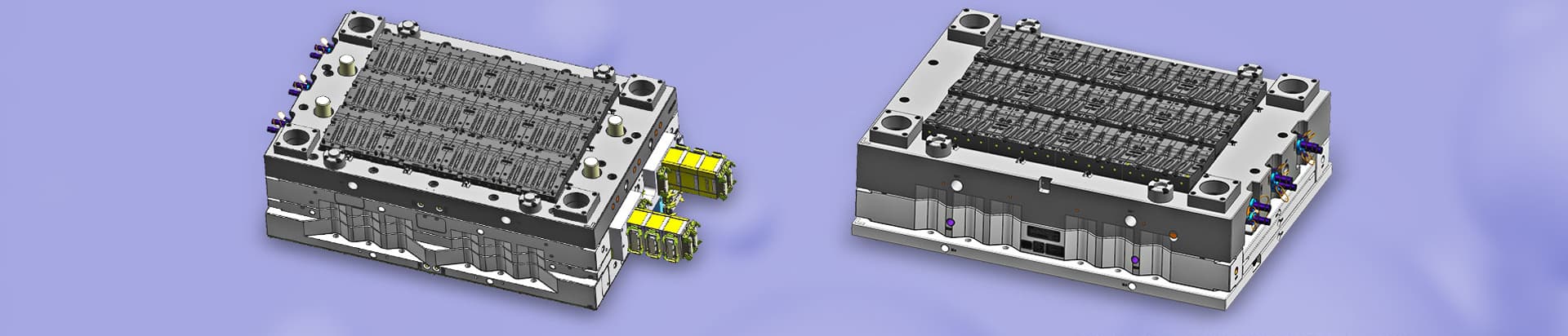
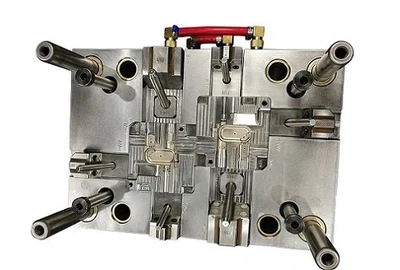
Each injection molding product at the beginning of the design of the first to determine its mold direction and parting line, to ensure that the core pulling slider mechanism as much as possible and eliminate the impact of parting line on the appearance.
1. After the direction of die opening is determined, the stiffeners, buckles, bulges and other structures of the product are designed to be consistent with the direction of die opening as far as possible, so as to avoid core pulling, reduce stitching line and prolong the life of the die.
2. After the direction of die opening is determined, appropriate parting line can be selected to avoid the inverted direction of die opening, so as to improve the appearance and performance.
1. Appropriate demoulding inclination can avoid product hair (drawing). The demoulding slope of smooth surface should be ≥0.5 degree, fine skin grain (sand surface) surface is greater than 1 degree, rough skin grain surface is greater than 1.5 degree.
2. Appropriate demoulding inclination can avoid product top injury, such as top white, top deformation, top broken.
3. When designing deep cavity structure products, the slope of the outer surface should be greater than the slope of the inner surface as far as possible to ensure that the mold core is not skewed when injection molding, get uniform product wall thickness, and ensure the material strength of the opening part of the injection plastic parts.
1. All kinds of plastics have a certain wall thickness range, generally 0.5 ~ 4mm, when the wall thickness is more than 4mm, it will cause too long cooling time, shrinkage and other problems, should be considered to change the product structure.
2. Uneven wall thickness will cause surface shrinkage.
3. Uneven wall thickness will cause pores and weld marks.
1. Reasonable application of reinforcement can increase product rigidity and reduce deformation.
2. The thickness of reinforcement must be ≤ (0.5 ~ 0.7) T product wall thickness, otherwise cause surface shrinkage.
3. The slope of the single side of the reinforcement should be greater than 1.5° to avoid top injury.
1. Too small rounded corners may cause product stress concentration, leading to product cracking.
2. Too small rounded corners may cause stress concentration in the mold cavity, leading to cavity cracking.
3. Setting reasonable rounded corners can also improve the processing technology of the mold, such as the cavity can be directly used to mill with R knife, and avoid low efficiency of electrical processing.
4. Different rounded corners may cause the movement of the parting line. Different rounded corners or clear corners should be selected according to the actual situation.
1. When the plastic injection molding parts can not be demoulded smoothly according to the direction of mold opening, the core pulling slider mechanism should be designed. Core-pulling mechanism slider can form complex product structure, but easy to cause product stitching, shrinkage and other defects, and increase the cost of the mold to shorten the life of the mold.
2. When designing injection molding products, if there is no special requirement, try to avoid core pulling structure. For example, the direction of the hole axis and the reinforcement is changed to the direction of the die, and the method of piercing the cavity core is used.

 Call us on:
  Email Us:
  1st Floor, Block1, No.3 Beiting Road, Houting Community, ShaJing Street, Bao'An District, Shenzhen City, Guangdong Province, China
  English
 Deutsch
 italiano
 русский
 français
 română
 العربية
 Español
 Polska
 日本語
日本語 한국어
한국어