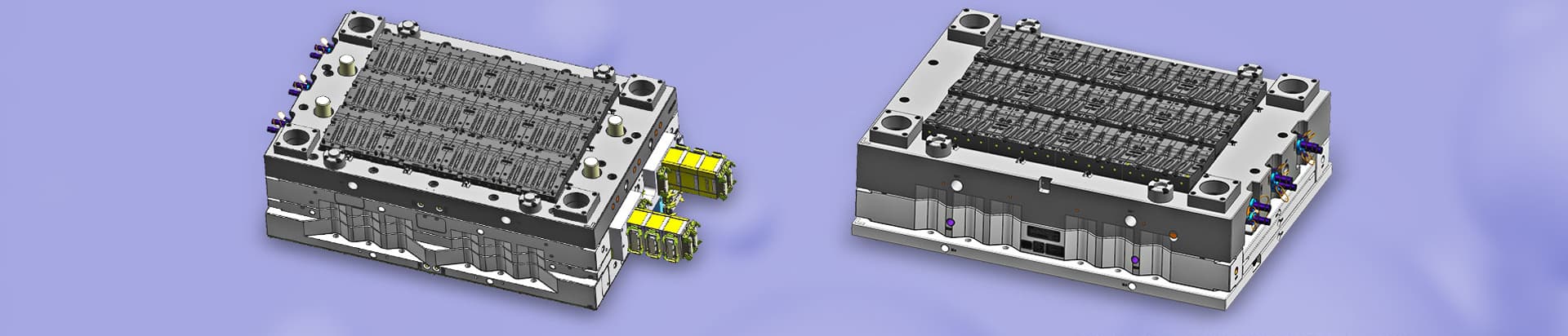
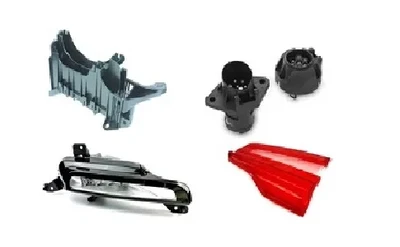
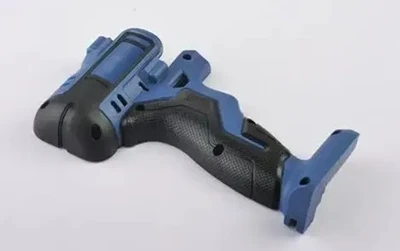
Overmolding is a method of injection molding in which an additional layer of material is added to an existing part. Usually soft resin is wrapped on hard plastic, and hard plastic is also wrapped with hard resin, usually for aesthetics or waterproof soft plastic.
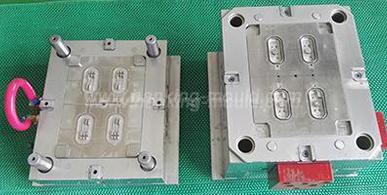
Overmolding is different to two shot mold, the two plastic materials are not necessarily injected on the same injection molding machine, and are molded in two time; after the product is taken out from one mold, the first plastic part is put into another mold for Injection molding production. Therefore, this molding process is usually completed by two sets of molds, do not need a special two-color injection molding machine.
Regarding Overmolding, as after the first color plastic parts is taken out, the second plastic parts(usually soft material) will need to be put into a mold manually for injection molding. It will extend the production time, increase the injection molding cost. Moreover, the two plastic materials of the overmolding are usually different. Their shrinkage rates and injection parameters are different. This requires experienced tooling engineers and designers to solve all possible problems in the design stage.
The decision for soft plastic depends also on the hard plastic material, HanKing Mould is very professional in overmolding technology, if you don't know which soft plastic to choose, contact us at yoyo@hanking-mould.com, our senior engineer will provide the most professional advice based on hard material characteristics and product functions.



 Call us on:
  Email Us:
  1st Floor, Block1, No.3 Beiting Road, Houting Community, ShaJing Street, Bao'An District, Shenzhen City, Guangdong Province, China
  English
 Deutsch
 italiano
 русский
 français
 română
 العربية
 Español
 Polska
 日本語
日本語 한국어
한국어