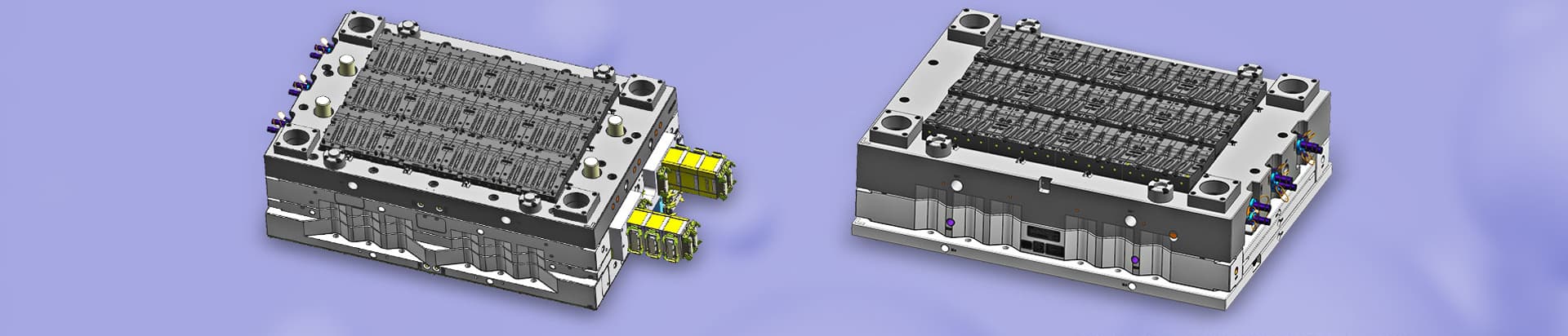
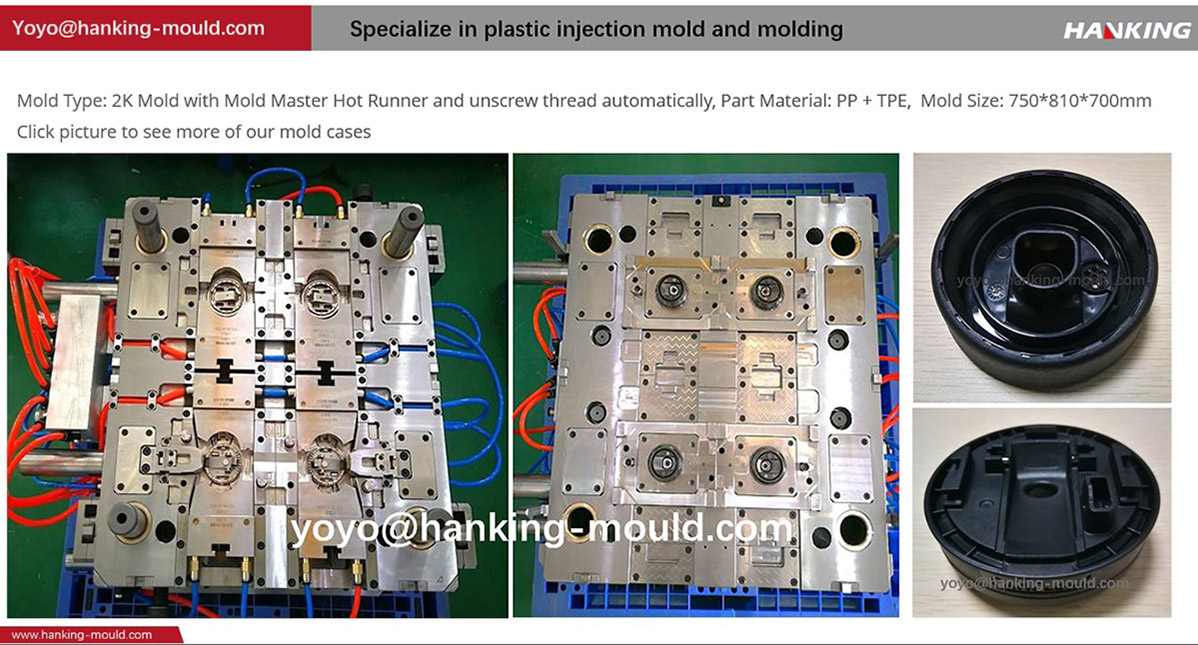
Mold sticking is a common issue during the molding of thermoplastic elastomer TPE/TPR soft rubber materials. This problem becomes particularly prominent when the material hardness is low, posing significant challenges to production and processing. The mold sticking phenomena of TPE soft rubber materials during molding are mainly divided into two categories: sprue sticking and product sticking. Among them, the mold sticking issue requires special attention in the overmolding (two-shot injection molding) scenario.
To address the sprue mold sticking problem of TPE/TPR soft rubber materials, targeted measures can be taken from aspects such as material property utilization, processing technology optimization, and accessory application, as detailed below:
2.1 Material Properties and Processing Improvement
The adsorption force of TPE/TPR materials increases with the smoothness of the mold surface. Based on this characteristic, EDM (Electrical Discharge Machining) can be applied to the gate bushing, retaining appropriate EDM textures. This method reduces the adsorption force between the sprue and the mold, thereby effectively preventing sprue sticking.
2.2 Application of Undercut Ejector Pins
Using undercut ejector pins in the style of runner pins can significantly enhance the force for pulling the sprue, facilitating smooth demolding of the sprue. Although soft rubber materials have good plasticity, the undercut angle still needs to be tested and adjusted following the principle of "from small to large" to ensure the sprue can be easily removed. It should be noted that if conventional Z-shaped pins are used, the sprue may adhere to the cavity mold due to insufficient pulling force, resulting in failure to demold normally.
The product mold sticking problem can be comprehensively solved through multiple dimensions such as mold design optimization, molding process adjustment, material selection and optimization, mold maintenance and cleaning, and other detail controls. The specific solutions are as follows:
Contrary to the mold treatment method for hard rubber resins, for TPE soft overmolding products, the male mold can be polished to a mirror finish to enhance adsorption force, while the female mold is subjected to sandblasting or texture processing to reduce the contact area between the soft rubber and the female mold surface. This reduces the adhesion force, guiding the product to stay on the male mold side more easily and avoiding sticking to the cavity mold.
The draft angle of the core mold can be appropriately reduced or even omitted entirely; when conditions permit, reverse draft design can also be adopted. This method enhances the holding force of the core mold on the product, preventing the product from adhering to the cavity mold.
Optimize the mold's vent structure to ensure smooth discharge of gas in the mold cavity during molding, reduce the gas pressure in the mold cavity, and provide favorable conditions for the smooth demolding of soft rubber products.
Reduce soft rubber adhesion by utilizing the temperature difference effect. Specifically, the temperature setting method of "low temperature for male mold, high temperature for cavity mold" can be adopted, that is, low-temperature treatment for the core mold and high-temperature treatment for the cavity mold. The temperature difference guides the product to separate from the cavity mold and attach to the core mold.
Properly reduce the molding temperature and holding pressure to reduce the fluidity of TPE soft rubber and its pressure on the mold, thereby reducing the possibility of adhesion. At the same time, adding cross ribs on the ejector pin head can effectively improve the demolding effect. In addition, during overmolding (two-shot injection molding), it is necessary to strictly control the injection speed and pressure to avoid excessive flow of soft rubber caused by too fast speed and too high pressure, which would aggravate adhesion.
Spraying mold release agent into the mold cavity before molding is a direct method to reduce mold sticking. It is recommended to select a mold release agent with better compatibility with TPE soft rubber to ensure the demolding effect while reducing adverse effects on the product appearance.
To control the mold sticking problem from the source, it is necessary to select appropriate TPE materials and improve their fluidity and demolding performance by adjusting the material formula system. In the design of two-color molds, the compatibility and fluidity of the two plastic materials should also be fully considered to ensure smooth separation and demolding during injection molding.
The cleanliness of the mold directly affects the mold sticking situation. Before injection molding, it is necessary to ensure that the mold surface is free of impurities such as oil stains and dust to avoid impurities affecting the contact state between TPE soft rubber and the mold. At the same time, the mold should be maintained regularly to check and clean the residues and impurities on the mold, keeping the mold surface smooth and clean.
In addition to the above measures, it is also necessary to strengthen the detail control of each link in the production process, such as real-time monitoring of the stability of molding parameters, regular inspection of the working status of demolding accessories such as ejector pins, etc., to timely detect and solve potential problems and ensure smooth production.


 Call us on:
  Email Us:
  1st Floor, Block1, No.3 Beiting Road, Houting Community, ShaJing Street, Bao'An District, Shenzhen City, Guangdong Province, China
  English
 Deutsch
 italiano
 русский
 français
 română
 العربية
 Español
 Polska
 日本語
日本語 한국어
한국어