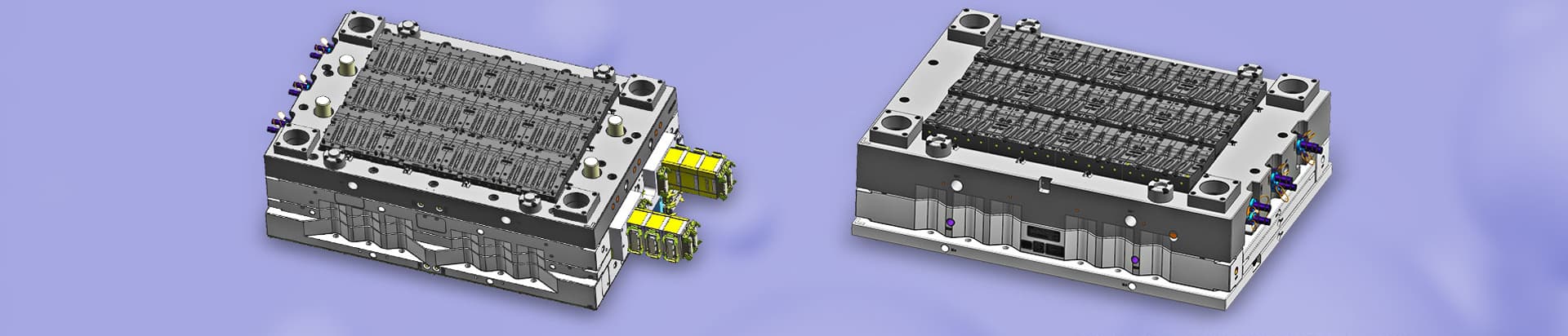
The minimum travel should be based on the depth of the reverse buckle plus a margin: the sliding distance of the slider should ensure that the product is completely detached from the reverse buckle area. Generally, the minimum distance that the product can be demolded should be added by 2~3mm, and some designs suggest adding 3~5mm.
The length of the inclined guide column should match the stroke: the effective working length of the inclined guide column can be calculated as L=S/sin α, where S is the horizontal stroke of the slider and α is the inclination angle of the inclined guide column.
Four sided sliders should have a safe distance: When there are sliders around the product, it is recommended to leave a safe distance of 5-10mm for core pulling to facilitate subsequent maintenance and repair.
The angle of the inclined guide column should be controlled between 15 ° and 25 °, with 18 ° to 20 ° being commonly used. If the angle is too large, it is easy to break, and if it is too small, the core pulling force will be insufficient.
The inclination of the shovel base should be 2 °~3 ° greater than that of the inclined guide column, so that the shovel base can reliably lock the slider when closing the plastic injection mold, preventing the formation of burrs due to backward movement under injection pressure.
The ratio of slider height to thickness should be reasonable, generally requiring a sliding length L ≥ 1.5 times the slider height H to avoid jamming caused by flipping torque during movement.
The two sides of the slider should have a slope, and the sealing surface should have a slope of 3 °~5 ° on one side. When two vertically moving sliders are in contact, the angle can reach 45 °.
The limit mechanism must be reliable: commonly used slingshot with limit blocks, wave screw limit, etc., to ensure that the slider stays in the correct position after injection mold opening and prevent damage to the inclined guide column during mold closing.
Add wear-resistant blocks and oil grooves on the sliding surface: The bottom of the slider and the matching surface of the shovel base should be embedded with wear-resistant blocks (such as P20 nitride or CR12 material), and the sliding surface should be machined with oil grooves for lubrication. Large sliders also need to be separately designed with cooling water channels.
The guiding device should be smooth: the pressing plate of ordinary molds takes priority over the T-slot principle, and the hard mold must be guided by a pressing plate. There should be no sharp corners or burrs around all sliding surfaces that hinder movement.
To prevent the slider from pulling the product: When the slider completely wraps around the side of the product, a side top device should be installed on the slider; Thin walled deep cavity products also need to have a top pin inside the slider to avoid deformation of the finished product due to pulling.
The slider mechanism is one of the core links in mold design, which affects the life and stability of the mold and directly affects production efficiency. We are a professional injection mold manufacturer. If you need to develop new products, please contact us.



 Call us on:
  Email Us:
  1st Floor, Block1, No.3 Beiting Road, Houting Community, ShaJing Street, Bao'An District, Shenzhen City, Guangdong Province, China
  English
 Deutsch
 italiano
 русский
 français
 română
 العربية
 Español
 Polska
 日本語
日本語 한국어
한국어