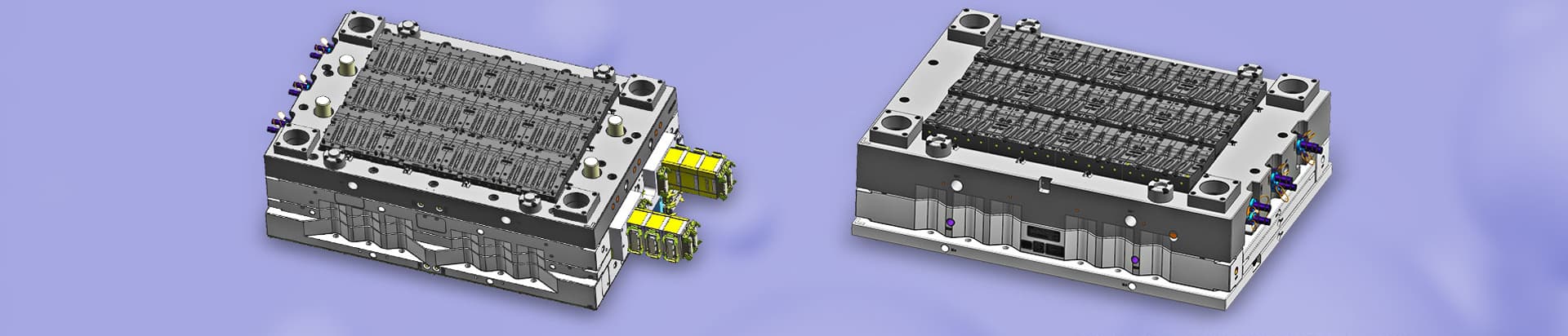
Draft angle refers to the angle at which a mold is designed, specifically the angle at which the formed part of the mold exits parallel to the direction of the mold.
The draft angle can be divided into front mold draft angle and rear mold draft angle, which are mainly distinguished by the parting surface. The parting surface divides the mold core into front mold and rear mold. The draft angle that needs to be designed for the surface parallel to the exit direction on the front mold is called the front mold draft angle, and vice versa is called the rear mold draft angle. In addition, if the mold has side core pulling (inclined top and slider), they are respectively called inclined top draft angle and slider surface draft angle, and the draft direction is based on the direction of slider movement.
The direction of demoulding is generally based on the parting surface, ensuring that the larger end after demoulding is close to the parting surface, otherwise demoulding cannot be carried out smoothly.
Draft angle is a process structure. In theory, if it is not required for molding, the product structure does not need to be designed with draft angle. However, due to the limitations of the molding process, such as injection molding plastic products need to be removed from the mold after cooling. If draft angle is not designed, it will be difficult to remove plastic parts from the mold. Recalling, you must have encountered a situation where it was difficult to separate plastic stools stacked together. That was already a stool with a designed slope, let alone plastic parts without a designed draft angle that needed to be removed from the mold.
Why is it difficult to remove plastic parts from the mold without designing a draft angle?
In injection molding, molten resin flows into the closed mold and fills the cavity formed between the front and rear molds. Due to the shrinkage of thermoplastic during cooling, the plastic tends to shrink towards the mold core, and the contracted plastic part will tightly adhere to the mold core. In addition, some plastics may detach from the mold cavity wall (at the microscopic level), but most still come into contact with the cavity wall.
During the process of opening the mold, whether the outer surface of the plastic part comes into contact with the cavity wall or the inner surface of the plastic part comes into contact with the core, the plastic part will experience a frictional resistance (static friction force) opposite to the direction of detachment from the mold. According to the formula of friction force: f=μ × Fn, it can be concluded that the magnitude of friction force is related to the roughness (μ) and shrinkage stress (Fn) of the contact surface; The shrinkage stress (Fn) is related to the draft angle.
After designing the draft angle, f=μ × Fn × cos α. The frictional force f in the direction of the mold release decreases with the increase of the draft angle α. Generally, the draft angle is not very large, and it is obvious that reducing static frictional force by relying on the draft angle is limited.
The main function of draft angle is that once the plastic part is detached from the mold, it will separate and no longer come into contact with the mold, eliminating friction; However, without designing a draft angle, the plastic parts become sliding friction after detaching from the mold. At the same time, for the high gloss appearance surface, the front mold cavity may also form a vacuum, and the vacuum suction force may make it difficult for the plastic parts to completely separate from the front mold. The worst result is sticking to the front mold and causing deformation of the structure of the rear mold of the plastic parts.



 Call us on:
  Email Us:
  1st Floor, Block1, No.3 Beiting Road, Houting Community, ShaJing Street, Bao'An District, Shenzhen City, Guangdong Province, China
  English
 Deutsch
 italiano
 русский
 français
 română
 العربية
 Español
 Polska
 日本語
日本語 한국어
한국어