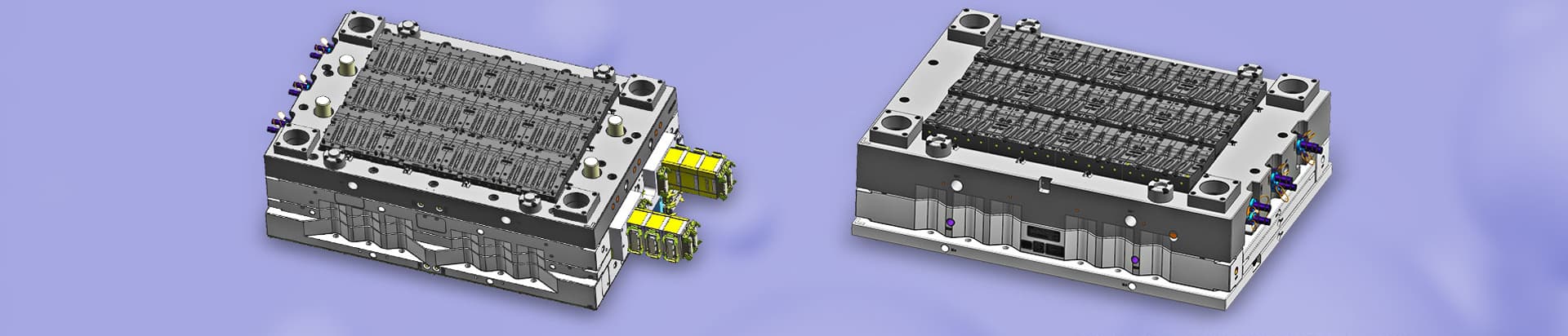
Principle of filling balance: Multi cavity molds must ensure that each cavity is filled and pressurized simultaneously, which can reduce the deformation of the product by more than 50% and significantly improve the consistency of batch production.
Principle of shortest flow channel: Within the allowable range of the mold structure, try to shorten the melt flow path as much as possible to reduce pressure loss and temperature attenuation, especially suitable for engineering plastics with high viscosity.
Principle of efficient pressure transmission: The flow channel section should adopt a gradient design to avoid sharp corners, reduce turbulence and pressure loss during the melt flow process, and ensure effective transmission of holding pressure to the mold cavity.
Principle of Adequate Exhaust: Exhaust grooves (depth 0.03~0.04mm, width 5~10mm) or exhaust plugs must be installed at the end of the plastic injection mold cavity filled with molten plastic and in the area where the weld line is formed, to ensure smooth exhaust of air from the mold cavity.
Principle of smooth demolding: The design of the runner should be coordinated with the demolding mechanism to ensure synchronous demolding of the aggregate and the product, avoiding demolding failures such as residual aggregate and gate breakage.
The hot runner system maintains the molten state of the melt in the channel through a built-in heating device, which has significant technical advantages compared to traditional cold runner systems and has been widely used in mid to high end injection molding production.
Core technological advantages: Material utilization rate increased by more than 30% (no loss of runner condensate), molding cycle shortened by 20%~30%, minimal gate marks, and automated continuous production can be achieved.
Single cavity insulated flow channel: relying on the self insulation of the melt to achieve insulation, with a simple structure and low cost, suitable for large thick walled products (long molding cycle, slow cooling of the melt).
Multi cavity heating channel: divided into external heating type (heating coil wrapped channel, simple structure, easy maintenance) and internal heating type (heating element built-in, good temperature uniformity, high temperature control accuracy), suitable for the production of precision products with multiple cavities.
Valve type sprue hot runner: By controlling the opening and closing timing of the sprue through a needle valve mechanism, step-by-step filling can be achieved, effectively reducing weld lines and improving molecular orientation. It is suitable for complex structural components with extremely high appearance requirements.
Large scale production of automotive interior parts, electronic and electrical casings, medical devices, high-value engineering plastic products, and other scenarios that require strict requirements for appearance quality and production efficiency.



 Call us on:
  Email Us:
  1st Floor, Block1, No.3 Beiting Road, Houting Community, ShaJing Street, Bao'An District, Shenzhen City, Guangdong Province, China
  English
 Deutsch
 italiano
 русский
 français
 română
 العربية
 Español
 Polska
 日本語
日本語 한국어
한국어