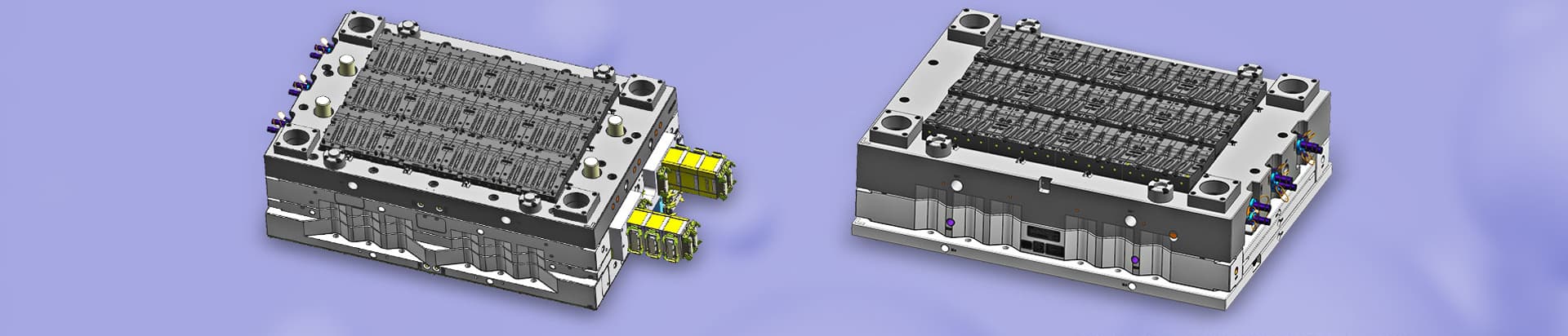
The most critical component of high-gloss injection molding is the mold temperature control system. The primary distinction between high-gloss and standard injection molding is the control of mold temperature, whereas the requirements for the injection molding machine itself are relatively modest. Often referred to as a high-gloss mold heater/chiller, this temperature control system works in conjunction with standard injection molding machines to synchronize actions throughout the injection cycle: filling, packing, cooling, and mold opening/closing.
Heat conduction: Heat is transferred to the mold surface via oil, water, steam, or electric heating elements running through internal channels.
Thermal radiation: Direct radiation from sources such as lasers, infrared light, flames, gas, or electron beams heats the mold surface.
Self-generated heat: The mold surface produces heat internally through resistance or electromagnetic induction.
Currently available and effective heating systems include: high-temperature oil heaters, high-pressure hot-water systems, steam heaters, electric tube heaters, electromagnetic induction systems, and infrared radiation systems.
Uniform heating/cooling channels are designed into the mold. The oil system preheats the mold and provides cooling during injection, with temperatures reaching up to 350°C. However, oil has low thermal conductivity, resulting in low efficiency; oil fumes also negatively affect surface finish, making performance less than ideal. Despite this, oil heaters remain common in industry due to widespread usage and experience.
Balanced channels inside the mold use water at varying temperatures for different stages: high-pressure superheated water for heating, and cold water for cooling. When pressurized, water temperatures can reach 140–180°C with very fast heat-up times. Manufacturers such as Aode offer GWS-series systems; since hot water is recyclable, operating costs are low. This is one of the most popular systems in China and the best replacement for steam.
Operating similarly to high-pressure water systems, steam is used for heating while cold water cools the mold (pipelines are usually dried with compressed air first). Steam can heat mold surfaces to 160°C. Since steam has lower heat capacity than water, heating takes longer—roughly 300°C steam is needed to reach 150°C on the mold surface. Steam cannot be recycled, requiring boilers and dedicated piping, which increases operating costs.
Installing electric heaters directly into molds is expensive and requires patent licensing for mold design. Heating is fast, with a range up to 350°C: the system can heat a mold to 300°C in 15 seconds and cool it to 20°C in another 15 seconds. However, it is only suitable for small parts, and the high temperatures shorten mold life.
Based on electromagnetic induction, this method heats workpieces quickly. Due to the skin effect, heat concentrates on the surface rather than the core, allowing targeted surface heating. Heating rates exceed 14°C/s, with systems developed by Taiwan’s Chung Yuan University reaching above 20°C/s. Paired with rapid cooling, it enables fast cyclic heating and cooling for dynamic mold temperature control.
Researchers are developing infrared systems that directly heat mold cavities. Infrared transfers energy via electromagnetic waves without a medium and offers good penetration. Advantages include energy efficiency, safety, simplicity, and ease of use. However, bright metals absorb infrared poorly, leading to slower heating.
Several challenges remain in temperature control systems: limited reliable heating methods (steam and high-temperature water are most successful); standalone systems requiring integration with injection machines; and high equipment and operating costs. The industry is focused on developing cost-effective variable temperature technology that does not extend cycle times. Future development will target low-cost, rapid heating methods and fully integrated high-gloss injection molding machines.
Rapid Heat Cycle Molding (RHCM): for fast heating/cooling cycles
Variable / Dynamic Mold Temperature Control: describing fluctuating mold temperatures
Spray-Free Injection Molding: eliminating painting and finishing
Weld-Line-Free / Mark-Free Injection Molding: eliminating surface defects




 Call us on:
  Email Us:
  1st Floor, Block1, No.3 Beiting Road, Houting Community, ShaJing Street, Bao'An District, Shenzhen City, Guangdong Province, China
  English
 Deutsch
 italiano
 русский
 français
 română
 العربية
 Español
 Polska
 日本語
日本語 한국어
한국어