Warpage is a common and challenging issue in injection molding. It not only affects product appearance but also causes dimensional deviations, preventing products from meeting application requirements. Fine-tuning injection molding process parameters can effectively minimize warpage and improve product quality.
Temperature is a core factor influencing plastic melt behavior and product cooling, directly impacting warpage. Key adjustments focus on melt temperature and mold temperature.
Melt temperature significantly affects plastic fluidity and molecular orientation, requiring precise control of both setting value and uniformity.
Excessively high melt temperature enhances fluidity but increases shrinkage during cooling, easily causing warpage. For example, overheating polycarbonate (PC) melts leads to intense molecular chain movement and rapid cooling shrinkage, resulting in uneven local contraction and warpage. PC’s optimal melt temperature range is typically 280-320℃, balancing fluidity and shrinkage control. Parameters must be tailored to material properties to reduce warpage risks.
Uneven melt temperature across runners and cavities causes inconsistent cooling rates, triggering warpage. Optimize mold heating systems (e.g., hot runner technology) to maintain consistent melt temperature, reduce temperature gradients, and lower warpage potential.
Mold temperature influences cooling rate and crystallization of melts, demanding optimized temperature difference and stability.
Uneven mold temperature leads to inconsistent product cooling. For crystalline plastics like polypropylene (PP), high mold temperature slows cooling, increasing crystallinity and shrinkage; low temperature causes rapid surface cooling but slow internal cooling, generating internal stress and warpage. Design targeted cooling channels—strengthen cooling for thick-walled areas—to minimize temperature differences between thick and thin sections, this can be set in
mold design.
Temperature fluctuations disrupt cooling stability and induce additional internal stress. Use high-precision temperature control systems (e.g., mold temperature controllers with PID controllers) to monitor and adjust mold temperature in real time, ensuring stable operation within set ranges.
Pressure parameters (injection pressure, holding pressure, holding time) affect melt filling and shrinkage compensation, requiring precise calibration.
Injection pressure determines melt filling quality in cavities, with improper values causing warpage.
Excessively high pressure leads to fast melt flow, strong impact, and high internal stress—warpage occurs when stress is released after demolding. Insufficient pressure results in incomplete filling and uneven density, also causing warpage. Adjust pressure based on product structure, mold design, and material properties. Thin-walled products require higher pressure for full filling but with strict limits to avoid excessive stress.
Adopt multi-stage
plastic injection technology: low pressure for stable initial cavity entry, increased pressure for mid-stage rapid filling, and reduced pressure in the final stage to prevent over-filling and internal stress. This optimizes melt flow and reduces pressure-induced warpage.
Holding pressure and time compensate for volume shrinkage during melt cooling, needing precise matching to product characteristics.
Excessive holding pressure creates internal stress; insufficient pressure causes shrinkage marks and warpage. Adjust based on product structure: lower pressure for uniform wall thickness, slightly higher pressure for thick-walled areas (avoiding overall overpressure).
Inadequate holding time leads to insufficient shrinkage compensation; excessive time increases internal stress. Determine optimal time through testing. For large plastic products, extend holding time appropriately while monitoring post-demolding deformation.
A well-designed cooling system ensures uniform product cooling, a key step in reducing warpage.
Reasonable layout and suitable cooling media are critical for cooling efficiency.
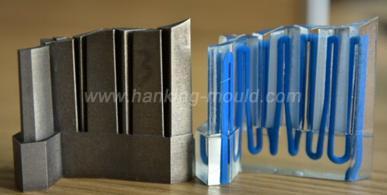
Design channels based on product wall thickness and structure. Increase pipe quantity/diameter for thick-walled areas to enhance cooling; reduce cooling intensity for thin-walled sections. Maintain uniform channel spacing to ensure consistent mold surface temperature.
Water is commonly used for its high specific heat and cooling efficiency. For high-precision products or special cooling speed requirements, thermal oil is an alternative—its wider temperature range enables better cooling control, reducing warpage from improper cooling rates.
Cooling time must balance warpage reduction and production efficiency.
Insufficient cooling leaves residual internal heat, causing post-demolding shrinkage and warpage; excessive cooling reduces productivity. Use mold flow analysis software or test runs to determine optimal time—shorter for thin-walled products, longer for thick-walled ones.
Monitor temperature changes across product areas in real time. Adjust cooling medium flow rate, velocity, or temperature to ensure uniform cooling speed, minimizing warpage from unbalanced cooling.
Injection speed and ejection parameters also impact product warpage, requiring careful optimization.
Controlled injection speed ensures stable melt flow and uniform pressure distribution.
Excessively fast speed causes turbulent flow, uneven internal pressure, and warpage. Use appropriate speed for smooth filling. For complex-shaped products, adopt variable-speed injection—reduce speed near cavity ends to avoid high-impact stress and warpage.
Apply multi-stage control: low initial speed for stable gate entry, adjusted mid-filling speed based on cavity filling status, and reduced final speed to ensure uniform melt distribution and minimize speed-induced warpage.
Proper ejection design prevents stress concentration and deformation during demolding.
Rational design ensures uniform force distribution. Improper position or insufficient quantity causes local stress concentration and warpage. Use mold flow analysis or test runs to determine optimal ejection points and quantity for smooth, deformation-free demolding.
Excessively fast or strong ejection impacts products, causing warpage. Adopt moderate speed and force to eject products slowly and evenly, reducing ejection-induced warpage.
Reducing injection molding warpage requires comprehensive optimization of process parameters. By fine-tuning temperature, pressure, cooling, injection speed, and ejection parameters, manufacturers can effectively lower warpage risks, improve product quality, and enhance production efficiency.

 Call us on:
  Email Us:
  1st Floor, Block1, No.3 Beiting Road, Houting Community, ShaJing Street, Bao'An District, Shenzhen City, Guangdong Province, China
  English
 Deutsch
 italiano
 русский
 français
 română
 العربية
 Español
 Polska
 日本語
日本語 한국어
한국어