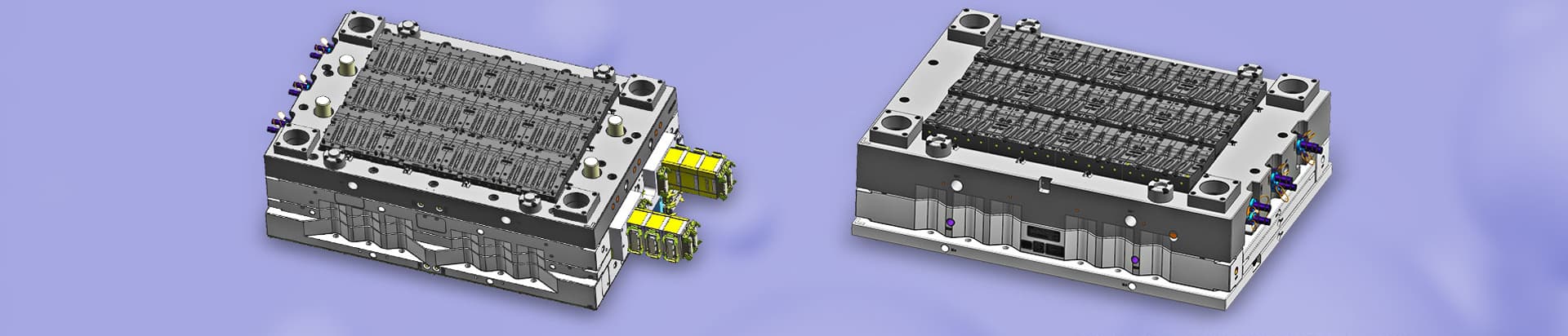
The core principle of the slider is to convert the vertical motion of the mold opening and closing into horizontal lateral motion, achieving the demolding of the lateral structure of the plastic part.
Diagonal guide column drive: The most widely used method is to use the inclined surface of the inclined guide column in conjunction with the inclined hole of the slider to convert vertical motion into horizontal core pulling motion of the slider during mold opening.
Applicable scenarios: Small and medium-sized molds with core pulling force less than 5 tons and core pulling distance less than 50mm.
Advantages: simple structure, low cost, and easy maintenance.
Disadvantage: When the core pulling distance is large, the bending strength of the inclined guide column decreases.
Hydraulic/pneumatic drive: The slider is directly driven by an external hydraulic cylinder or air cylinder.
Applicable scenarios: large plastic parts (such as car bumpers), long stroke core pulling (greater than 100mm), high-precision requirements.
Advantages: High core pulling force, long stroke, and strong controllability.
Disadvantages: Complex structure, high cost, and the need for additional hydraulic stations.
Bending pin drive: Upgraded form of inclined guide column, adopting a rectangular section gradient structure.
Applicable scenarios: large angle core pulling (up to 30 °), complex lateral structures.
Advantages: High bending strength and good rigidity.
Disadvantages: High machining accuracy requirements and higher cost than inclined guide columns.
Diagonal slider separation and core pulling: The slider is pushed along the inclined guide groove by the ejection mechanism.
Applicable scenarios: Plastic parts with shallow lateral concavity and convexity (depth less than 5mm).
Advantages: Compact structure, reduced mold thickness.
Disadvantages: Narrow applicability and limited core pulling force.
The design of the plastic injection mold slider requires strict control of the following parameters to ensure smooth movement without affecting the quality of the plastic parts.
Angle matching:
The inclination angle of the inclined guide column is 15 ° -25 °, commonly 18 ° -20 °.
Locking block (shovel base) angle: 1 ° -3 ° greater than the angle of the inclined guide column to prevent self-locking or jamming during mold closing.
The overall inclination angle of the slider should not exceed 25 °, and if exceeded, it needs to be reinforced in the design.
Coordination gap:
The clearance between the slider and the plastic injection mold core is 0.02-0.05mm on one side.
The tolerance for the fit between the inclined guide column and the slider hole is H7/h6.
A gap that is too small can easily get stuck, while a gap that is too large can cause flying edges.
Structural strength:
The ratio of slider height to thickness: ≤ 1.
Slide length L: ≥ 1.5 times the height H to ensure rigidity.
Hardness of easily worn parts: HRC55 or above, surface nitriding or heat treatment.
Travel itinerary calculation:
The horizontal movement distance of the slider S=the depth of the finished product hook T+2-3mm safety margin.
The length of the inclined guide column L=S/sin θ (where θ is the inclination angle).
The common faults and on-site handling methods of sliders are as follows.
The slider is stuck:
Possible reasons: The clearance is too small, lubrication is insufficient, and thermal expansion causes the clearance to disappear.
Solution: Polish the contact surface, add graphite lubricant, and reprocess the oil groove (depth 0.5mm, cross or diamond shaped).
Prevention: Regularly check the positioning screws and elastic positioning components.
Plastic parts adhesive slider:
Possible reason: Insufficient demolding slope.
Solution: Increase the demolding slope of the slider surface (≥ 3 °).
Inadequate reset:
Possible reasons: spring fatigue, wear of limit block.
Solution: Use nitrogen gas springs and replace hard alloy limit blocks.
Prevention: Replace ordinary springs with nitrogen gas springs in high-precision situations.
Surface wear or scratches:
Solution: Use a fine-grained oilstone dipped in machine oil to gently polish along the sliding direction, avoiding coarse sandpaper.
The hardness standard for wear-resistant blocks is HRC52-56, which is 2-3 degrees higher than the slider body.
Low cooling efficiency:
Possible reason: Unreasonable waterway design.
Solution: Adopt a conformal waterway and increase turbulent structures.


 Call us on:
  Email Us:
  1st Floor, Block1, No.3 Beiting Road, Houting Community, ShaJing Street, Bao'An District, Shenzhen City, Guangdong Province, China
  English
 Deutsch
 italiano
 русский
 français
 română
 العربية
 Español
 Polska
 日本語
日本語 한국어
한국어